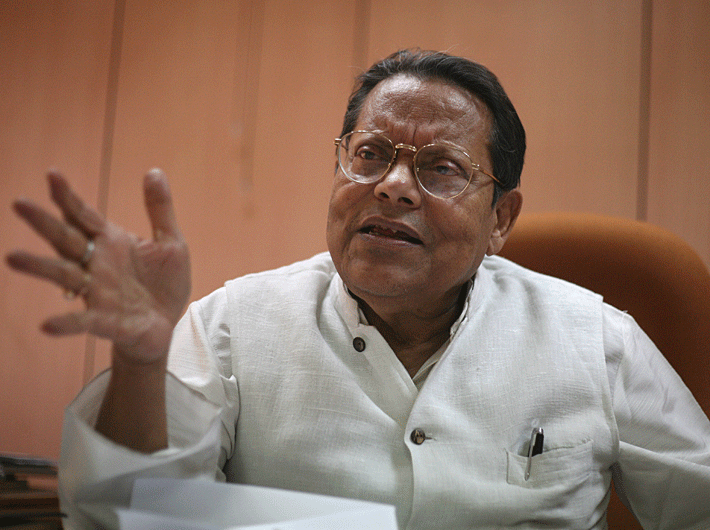
Nitish Sengupta, a renowned economist and a career bureaucrat, is at present chairperson of the Board for Reconstruction of Public Sector Enterprises (BRPSE), which is mandated to examine cases of sick central public sector enterprises (PSEs) and recommend their revival or closure. The board is also mandated to monitor emerging sickness in PSEs.
Out of 248 central PSEs, 67 have been referred to the BRPSE. The board has received proposals for 62. Of these, 59 have been recommended for revival and three CSPEs for closure.
In conversation with Governance Now, Sengupta highlights the problems with sick public sector units (PSUs), how they are being revived, and the challenges involved in reviving sick enterprises. Edited excerpts:
Has the PSU sector on the whole been able to keep pace with economic liberalisation?
Yes they (PSUs) have been. We must not forget that the real problem started after 1991. Till 1991, our economy was a closed economy – inputs were not allowed, there was very little competition, so PSUs were making good profit. But the perspective changed after that: competition was introduced and, at the same time, foreign investment was permitted and imports were liberalized, so that things could be imported.
Take the case of Indian Telephone Industry Limited (ITI). It was a profit-making company till 1991 but after that they started falling gradually, because it could not face the competition and did not change its technology as well. It became a sick company.
How important is the role of PSU economy in the nation’s overall economy?
When we started our planned economic development, private sector was not forthcoming in a quite a lot of areas because of the huge investments involved. Therefore, the government had to willingly come into it for a number of industries gradually. We had restricted and closed economy, and therefore, it was necessary for the government to step in. The industrial policy resolution of 1956 laid down a huge area which was only open to public sector and not to private sector. So the private sector’s role was very much restricted. That situation changed after the industrial revolution of 1991, when areas reserved for the public sector were brought down to only 3 or 4.
What are the factors that have worked for successful PSUs? Have they provided any lessons useful for sick PSUs?
There was a company called Hindustan Cables, which was making copper cables and it was performing well. The technology completely changed from copper cable to optical fibre. But this company never changed its technology and products and gradually it started falling. Wherever a company is making products which are acceptable to the market, it will make profit. And where the company has lost its market and products are no longer acceptable because it has not taken the trouble to change the technology, it makes loses.
Most of the sick PSUs did not cut down on production. Nor did they retrench employees. Sick PSUs should bring change in management and should change their products and technology with time.
What factors do you think are responsible for sickness of a PSU?
One example I will give you is of Heavy Engineering Corporation Limited. It was meant to be almost a captive unit for the Steel Authority of India (SAIL). We were establishing steel unit almost every second year that time and we were importing its machinery from abroad. So the idea was why not set up a factory to make those machineries here and HEC was set up. But then steel industry went into recession. And for several years, no new steel unit was set up. And it was not open to the private sector either. So HEC became a sick company.
We had to tell them that why they only think of supplying to SAIL and why not other companies which may need products made by them. So they adopted that change and later started selling products to other companies like Larsen and Tubro (L&T) and Nuclear Power Corporation and they made profit after nearly two decades.
So the fact that PSUs do not change the technology and products with time results in their sickness.
You had said that the PSUs have been totally dependent on government orders so far and that mindset has to be changed. How will you do that?
We have to change that in some companies like Hindustan Photo Films. Today the technology has changed and the photography has become digital. So no films are being produced for that camera. They did not change their technology. We have tried our best by giving them new products but nothing much has happened.
Changing the mindset is important and it is not an easy thing to do, especially, when for a whole generation you have been accustomed to have a completely captive market. That psychology has to be changed.
The solution for this is to try and get the right kind of people on board. In Indian Drugs and Pharmaceuticals Limited (IDPL), we are thinking of changing the management completely. It also has lot of land and if part of that land is sold, that will give them enough money.
In Gurgaon, IDPL has not used some portion of its land. If sold, they can easily get some Rs 9,000 crore, so why do they need government’s money. And the government is not even in a position to give more money to many of them. They must accept that reality.
So you are saying that when there is surplus land, you ask PSUs to utilise it properly, say by selling some portion of it?
There are quite a lot of such PSUs which have huge land. Like the textile company in Kanpur has lot of land. But the UP government is not giving them permission to sell that land.
What are the glitches in converting their assets into cash?
Sometimes it is the state government which puts up hurdles. And there are PSUs which have huge land but they do not think in terms of commercial exploitation of it. Like in Bengaluru, HMT has a lot of land. Why shouldn’t they think of using the land, which can give them enough money?
How many of such enterprises have sold their land assets or are planning to do that?
National Textile Corporation is one such enterprise which has already sold a lot of their land and they are sitting on huge cash.
What would be the value of the total land assets with loss making PSUs?
It is huge money. IDPL has so much land in Rishikesh that there was a proposal for the Uttaranchal government to construct part of their capital there. Jharkhand state has taken a lot of land from HEC to build up their assembly and secretariat there and it gave money in return.
How are the enterprises which have been given the revival packages performing? Are there any enterprises which are not utilising the packages given to them?
Some of them are performing well. Like Konkan Railway Corporation is doing really well. But there are some which are not doing well even after getting the revival package like Electronic Corporation of India Limited. They have utilised the package but the demand of the products in the market has gone down.
Right now there is a situation of recession in the market and that is affecting them.
How are sick PSUs short-listed for revival packages? How is the revival package decision taken?
PSUs are not short-listed. The ministries refer the cases of their sick PSUs to the board and then we study them. It is an ongoing process and we try to understand the reason why it became sick and then give our prescription.
We go through its balance sheet of three years and see why it has reported loses and the reasons for the losses. There are many reasons; sometimes they don’t have the working capital, or there is a question of giving subsidy or sometimes the government has lot of loans due on these companies. So we recommend that loans can be converted into the equity. In any case, the government is not getting these loans back, but as equity the companies start functioning well, there would be the possibility of the government getting its money back through the dividend declared.
Or if the products are not accepted by the market, we see if there is a need to go for a new product or there is a need to change the technology, which might have become outdated. And if the labour force of the employee strength is very high, beyond the capacity of the company, we recommend bringing it down.