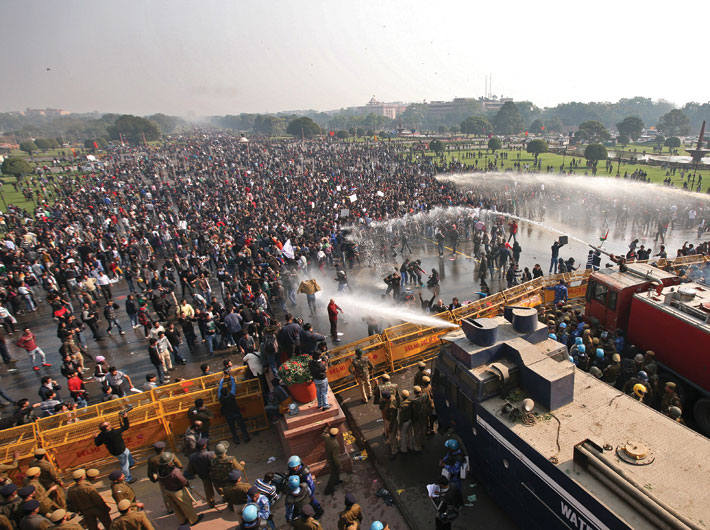
The case against Zee News for airing interview of her friend is proof that it is no longer about protecting the victim's identify. It is about obliterating her memory
(In view of the revived debate over the naming of the victim, we are reproducing this article)
It's a very thin line between the sacred and the profane. Even those in elementary classes in journalism schools are taught without demur that the basic job of a reporter is not to hide facts but to reveal them in all detail. Even if it means going on the wrong side of the law, journalists would be failing in their sacred duty if they conceal facts that reveal the truth.
But the media coverage of the ghastly Delhi gangrape has turned out to be a case of the sacred getting mixed up with the profane. The manner in which the mainstream media acted in cahoots with the government and the Delhi police would serve as a perfect example of a remark often attributed to Indira Gandhi about the conduct of the media during the emergency, "They were asked to bend but they started crawling."
The Delhi police, whose dubious conduct in the whole affair is not a secret, went overboard to protect the identity of the rape victim and zealously guarded the truth from coming out on the pretext of a law which prohibits revelation of identity in the larger interest of the victim. There is no doubt that the decree to protect the rape victim's identity is guided by a pernicious social mind-set which attaches blemish to the victim rather than the perpetrators of the crime.
This rape-cum-murder case was different in many aspects. The extent of bestiality involved was beyond human imagination. At the same time, it exposed the abysmal failure of a contract of the state with the citizenry at every step of our routine life. For instance, the victim and her friend could not get safe public transport after waiting for hours. Three-wheelers refused to take them to the desired destination despite an undertaking by them that they would not refuse passengers.
That the chartered bus bearing the name "Yadav" was allowed to ply on Delhi roads for hours in the night without valid papers is a testimony to a criminal nexus between the police and transporters. That the transport department of the Delhi government has been a den of criminal-transporter-authority nexus and a source of ill-gotten wealth is hardly a secret. The rape victim’s trust in the state was completely betrayed even in the hospital where she was subjected to ordeals of inquisition at the first instance instead of getting medical aid.
This was not a fictionalised Bollywood story of a "Nirbhaya” or a “Damini" who either found a saviour in a celluloid hero or put up a fight of mythological proportions. She was violated and bruatalised. Her "hero" was beaten to pulp. And then they were betrayed at every step by a collusive state which professes to protect its citizenry. Her desire to protect her identity was only guided by her instinct to survive. But she wanted to speak of every minute of her ordeal to give a perfect narrative of her betrayal by the state, society and the elite. That was why she asked for burning her tormentors alive in punishment. No, this was not a Bollywood movie, but that is exactly what the media has made it out be.
Perhaps every minute of the lives of the victim and her friend since December 16 would confirm the state's role as a criminal enterprise. And erasing the memory of the girl and her friend became the state’s first priority. Curiously enough, the mainstream media actively colluded with the state in this endeavour and blacked out the coverage of the funeral of the unfortunate victim whose only fault was her gullibility in reposing unflinching faith in the institutions of society and the state.
On the other hand, the state, rattled by the outpouring of people's anger, took the shield of law and morality to prevent skeletons tumbling out of its cupboard. In fact, the fierceness with which the Delhi police have been trying to guard the identity of the victim and her friend is no match for its efficiency in tackling the crime.
That is why the Delhi police are so shaken by the Zee News interview with the victim's friend (aired on Friday night). The friend’s narrative of the events on that dark night was in stark contrast to the myths woven around the victim by the state and a pliant media. The state's hideous face was exposed and its efforts to keep the ghastly incident "faceless" blown to bits. The cases filed against newspapers and journalists for revealing the true story is a panic reaction of the state whose project to efface the memory of the Delhi rape victim and replace it with a convenient mythical narrative through mainstream outlets was suddenly grounded. (Why is there no outrage at this sordid intimidation of the media?)
One simple question, "whose interest does it serve to hide her identity even after her death?" is not being asked by any media outlet. The rape victim’s name and identity are known in her home town in Ballia and entire eastern UP. In Delhi, everybody who matters to the family knows the identity and there is no indication that the family is facing any trouble because of that. The family itself has said that they are not scared of revealing their identity or ashamed of living on as the family of a rape victim. It is only the state and a section of the mainstream media which are keen on perpetuating the myths to obliterate the reality.