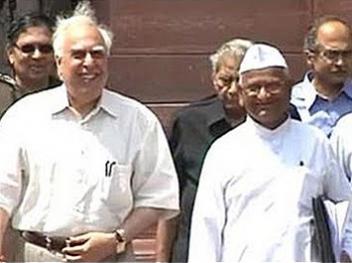
Kapil Sibal’s two-part article in the Hindustan Times (‘A free-floating entity’ and ‘Up the garden path’) trashing Team Anna’s version of the Lokpal Bill is breathtaking in its sweeping comments. Had he not been an eminent lawyer that he is one would have dismissed him for being political with the attendant licence to spread lies to deceive the citizens. But being an eminent lawyer, he needs to be questioned for writing an eminently trash-able article.
Here is a list of his half-truths, untruths, myths and misconceptions about our constitution and parliamentary democratic set-up vis-à-vis the Jan Lokpal Bill:
Sibal repeatedly describes the Jan Lokpal as a body of “11 unelected wise men”, “unelected executive body” etc. The emphasis is on “unelected”.
If such is the sanctity of the election, why isn’t he asking the “topmost executive” of the land, the prime minister, to get elected first? The PM is not only “unelected” for seven years running he is “unelectable” too. Shouldn’t he begin his crusade against the PM first for violating the “essence of parliamentary democracy”? How does he stand the topmost executive of the country who is no more than a “nominated” person?
Besides, which of these authorities wielding immense power is elected – CJI, CJs of high courts, judges of high courts and supreme courts, lower judiciary, DGPs, CBI director, CVC?
Sibal says, “The judiciary seeks to protect citizens. The (Jan) Lokpal seeks to prosecute them”.
Why, pray, has the government prepared the Judicial Accountability Bill? Why the impeachment move against Justice Soumitra Sen? Why is the CBI trying to prosecute Justice Nirmal Yadav of the Punjab and Haryana high court in the cash-for-judgment scam? Why a probe has been ordered against former CJI KG Balakrishanan for amassing disproportionate assets?
Sibal says Jan Lokpal “seeks to arrogate to itself the power to discipline government servants” and that it will require a “mammoth machinery” to deal with corruption acts of about 10-12 million government servants.
But then what is the purpose of the Prevention of Corruption Act and other such laws and bodies like the CBI and the CVC? How are they managing to discipline 10-12 million government servants? The Jan Lokpal seeks merger of the CBI and CVC with itself, so why will it need “mammoth machinery”?
Sibal also says the constitution “protects the tenure” of government servants and hence it would need constitutional amendment if disciplinary power is given to the Jan Lokpal.
Is this the reason why our anti-corruption machinery has failed? Then, please immediately amend the constitution.
Surely, the Congress is not afraid of constitutional amendments. Indira Gandhi did it with impunity, suspending our fundamental rights, cut to size the apex court by imposing her own man as CJI, cut down powers of the higher judiciary during the Emergency. Rajiv Gandhi tried to gag the media. Did Sibal as much as wince once, even if in private, when these draconian laws were being made? Did he ever protest against Emergency and suspension of our fundamental rights?
Sibal says Jan Lokpal is seeking to prosecute MPs who are protected by the constitution to vote and speak freely in parliament.
Does the constitution protect the MPs to take bribes to vote? Does he support exoneration of the MPs involved in the JMM bribery case? And what pray has happened to the more recent cash-for-votes scam? Was it protected by the constitution too? Do you regret that about a dozen MPs were thrown out for taking money to ask questions?
Sibal is against Jan Lokpal having power to intercept telephone conversations.
Surely, a Jan Lokpal didn’t bug finance minister Pranab Mukherjee. The Niira Radia taps were also not the handiwork of the Jan Lokpal. What does this talk of the system that Sibal is so zealously trying to protect?
Sibal says Lokpal will prosecute judiciary too.
This is mischievous to say the least. All Lokpal will have is the power to sanction investigation against a judge. The problem with the present system is a judge caught in a corruption case can’t be investigated without the court’s permission and that is why Justice Nirmal Yadav was allowed to retire peacefully. Will a similar mechanism to sanction investigation not be part of the Judicial Accountability Bill?
And finally,
Sibal says “some eminent jurists believe it might fall foul of the basic structure of the constitution” and that it is “answerable to none” (government, parliament and judiciary).
Really? Will the Lokpal not be debated in and passed by the parliament?
And to say it is answerable to none is absurd.
Answerable to the government: Since all answerable anti-corruption mechanism has failed, the idea is to set up a body “independent” of the government.
Answerable to parliament: Just as parliamentary committees oversee work of CVC, PSUs, a similar mechanism can be applicable to the Lokpal. Besides, annual report of the Lokpal can also be tabled in parliament on which debates etc can be conducted. Simple, isn’t it, Mr Sibal?
Answerable to judiciary: Since all decisions of the Lokpal will be subjected to review of the high court and then supreme court, it will be subjected to the judiciary. Isn’t it?