Delhi gangrape & murder: hail the fast-track court

From the first day of trial till sentencing, fast-track court took 7 months and about as many days – no mean achievement but it needs to spread to other cases as well, say legal experts

jasleen

Jasleen Kaur | September 12, 2013


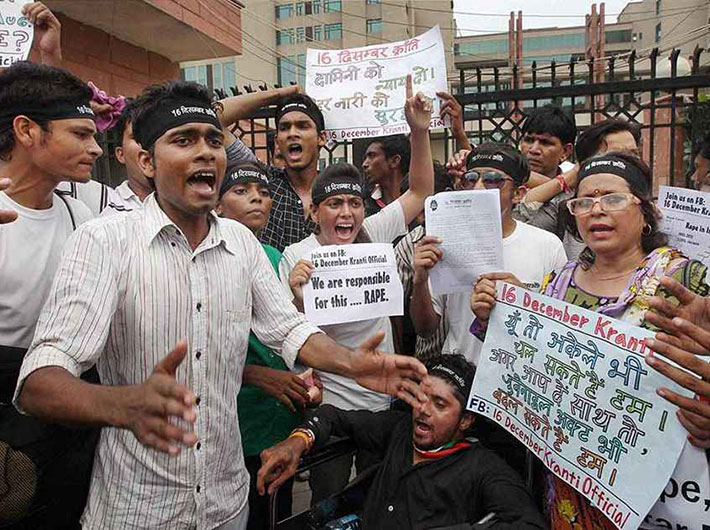
Protestors call for death for the December 16 rapists outside Saket district court, where four of the six were convicted on September 10.

Despite what the critics and naysayers will say – and say they must, most of them critically – the judgment in the December 16 Delhi gangrape case is an eye opener in more senses than one.

First, cases can be cracked, as they ought to, if the police step on the gas.

Second, conviction of rapists and/or murderers can happen, as they ought to, in the Indian legal system.

And third, they can happen within a decent period of time, before moss grows on the case files in some corner of the court premises.

While the social media, and indeed some sections of the media, have been critical of the time it took for the case to be decided, additional sessions judge Yogesh Khanna at the fast-track court in Saket district courts deserves kudos for once. This, in fact, was the first rape case he has heard in five years in which he convicted the accused.

Look at the numbers: from the day the fast-track was set up by the Delhi high court (December 23, 2012) to the first day of the trial (February 5, 2013) and announcement of the quantum of punishment (scheduled for September 13), it was less than nine months. In the seven months and nearly as many days since the trial began, the court heard 85 prosecution witnesses and 17 defence witnesses in over 130 hearings. Not an insignificant figure by any stretch of imagination, as lawyers and legal experts point out.

While a fast-track court is supposed to hold hearings every day, it practically isn’t so, says Barnali Basak, a senior supreme court lawyer.

Among questions raised by the critics is the fact that ASJ Khanna took three days between saying the four men, accused of raping and battering a 23-year-old physiotherapy student in a Delhi bus on December 16 last year, are guilty of rape and murder, among others, and pronouncing the quantum of sentence. Legal experts say that may be the emotional demand of the time but not practical, as courts have to write voluminous reports that take time. Ergo, judgments cannot be pronounced pat – like they show in Bollywood.

According to Basak, even a fast-track court has to follow the code of criminal procedures (CrPC). “We need to understand that it was a complicated case, and 89 witnesses were examined. It has to be a fair trial. A regular court would have taken three or four years to announce the verdict,” she said.
Stressing that the judgment in this case was delivered at a fair clip, with many matters pending for over 10 years, Basak, however, said there is scope for improvement even here. The Delhi gangrape verdict, she said, could have come “faster but that depends on the court. A criminal case is built entirely on evidences at hand. So it does take time”.

She pointed out that Rajasthan had set a precedent by convicting a rape accused in less than a month. Two days after a German tourist was raped in Jodhpur in May 2005, the high court had ordered that the probe be completed in a month. The result: a fast-track court in Jodhpur delivered the verdict in 21 days.

Anant Asthana, a senior lawyer with Human Rights Law Network, said a lot more needs to be done to ensure litigation in such cases is not an unending affair. “The December 16 case had a lot of significance and media attention. But it does not mean that the verdict would come out soon in other cases of sexual abuse or rape that do not grab media attention,” he said.

He also emphasised that in ensuring speedy justice, the rights of victims and accused cannot be compromised. As legal experts say, a trial in a criminal case – especially one that has death sentence or life imprisonment as punishment – cannot be hurried unduly at the expense of being a fair trial.
But what the Delhi gangrape case has done is show the country that there’s hope – when the police get up lace up their boots and when the legal system dusts the files and gets active.

Comments


Other News

India lost Rs 52,000 crore to cyber fraud in five years: DoT

India has lost more than Rs 52,000 crore to cyber fraud over the last five years, officials have revealed. Out of approximately 60 lakh cyber fraud complaints received, more  than 3,000 cases have been resolved and six cyber fraud setups have been busted.   On the occ

India must not wait for its own Ella

In many Indian cities, children learn to wear masks before they are old enough to understand why. That reality should alarm us far more than it does.   In 2020, nine-year-old Ella Adoo Kissi Debrah became the first person in the world to have air pollution officially recognized a

An ode to the cradle of humankind

The Alphabets of Africa: Poems By Abhay K. Vintage Classics, 280 pages, ₹499.00   Abhay K

Ahmedabad district railway network to be expanded

The Cabinet Committee on Economic Affairs, chaired by prime minister Narendra Modi, on Wednesday approved the Ahmedabad (Sarkhej) – Dholera Semi High-Speed Double Line project of Ministry of Railways with total cost of Rs. 20,667 crore (approx.). It will be Indian Railways 1st semi high-speed project

Indian Ocean more contested than ever: Western Naval Command Chief

The Indian Ocean is becoming increasingly contested and strategically significant as the Indo-Pacific emerges as the defining geopolitical theatre of the 21st century, Vice Admiral Krishna Swaminathan, Flag Officer Commanding-in-Chief of the Western Naval Command, has said.   Spe

Why the judiciary needs much more than four more judges

India has a particular form of governance theatre: the bold declaration that appears to be action but is actually a way of avoiding action. The Union Cabinet on May 5 approved a Bill to increase the sanctioned strength of the Supreme Court from 34 to 38. The decision has been touted as a step toward judici


Archives

Current Issue

Opinion

Facebook Twitter Google Plus Linkedin Subscribe Newsletter

Twitter