
India in their mind

An ambitious attempt to render a 2,500-year history of imagining India

shreerupa

Shreerupa Mitra-Jha | April 29, 2014
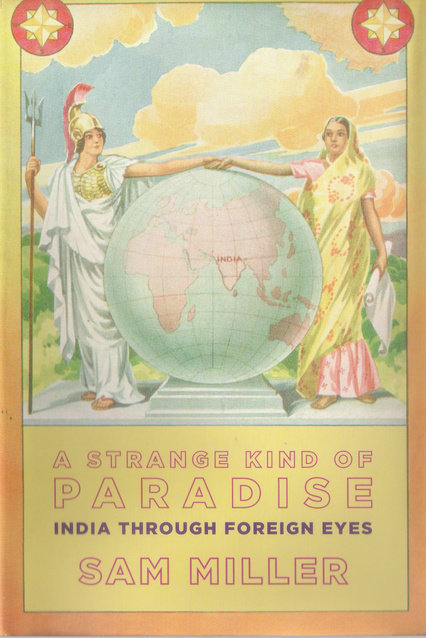


Book review: A Strange Kind of Paradise: India Through Foreign Eyes: Sam Miller (Interview): Penguin India, 440 pages, Rs 599

Edward Said in his book Culture and Imperialism argues thus: “Just as none of us is outside or beyond geography, none of us is completely free from the struggle over geography. That struggle is complex and interesting because it is not only about soldiers and cannons but also about ideas, about forms, about images and imaginings.” Miller etches well his struggle with geography and the historical struggle over the imaginative geography of India. He achieves this by an interesting narrative structure. The author, who is British,  simultaneously traces his 25-year journey in India with 2,500 years of  historical imagining of India by ‘outsiders’; the Greeks, the Romans, the 14th century Arab travellers, the 16th century Jesuit missionaries, traders of the 15th century, and the Renaissance thinkers, among others.

Readers looking for serious scholarship will be disappointed. It is engrossing in a history-made-fun sort of a way. The author is obviously well travelled in India. The book is liberally sprinkled with lesser known facts which a Lonely Planet guide on India may not provide: Pondicherry museum has the oldest European artifact (from the time of crucification) in India, Patna museum has a fragment of Tripitaka’s skull which was presented by the Chinese government to India in 1950, Muhammad bin Tughlaq’s palace is on the Outer Ring Road of Delhi below the IIT flyover called Bijay Mandal, Rose Aylmer’s (Landours’ love interest) pinecone-shaped tomb is in the Park Street cemetery of Kolkata, there is a light and sound show at the Cranganore church where St. Thomas first set foot in AD 52, India’s first mosque, again in Cranganore, was built in AD 629 and so on.

The chapters on personal history are called ‘intermissions’. The intermissions work well but sometimes begin and end rather abruptly.  The other chapters touch upon the known historical facts but concentrate more on the personality quirks of historical figures— the irascible but cowardly Vasco da Gama, the generous with outsiders but otherwise ruthless Tughlaq, the satyrical Ibn Battuta, the curmudgeonly St. Thomas are a few instances. History in this book, however, is his story.  Understanbly so.  It is much harder to access women’s early accounts on India, if any. Predictably, women’s voices come only with the East India Company. Having said that, Miller’s book even in its light-mode rendering of history, tackles a huge temporal sweep quite dexterously. He begins with Scylax, the great seafarer who returned from a scouting trip down the Indus in BC 500 and was said to have met people whose feet were so large that they could shelter themselves from the midday sun and ends with Steve Jobs in 2008 who describes Indian villagers as having more intuition than rationality.

The book bears what is becoming Millers’ signature style—each chapter begins with a hand-drawn map. The chapters are quirkily titled. For instance, the fourteenth chapter is called In which the Author quizzes his neighbors, gets a vague idea of the dimensions of Roberto Rossellini’s penis and watches far too many movies. An easy style combined with a knack for correlating random facts, A Strange Kind of Paradise makes for a light, engaging read.

Comments


Other News

AI: Code, Control, Conquer

India today stands at a critical juncture in the area of artificial intelligence. While the country is among the fastest adopters of AI in the world, it remains heavily reliant on technologies developed elsewhere. This paradox, experts warn, cannot persist if India seeks technological sovereignty.

RBI pauses to assess inflation risks, policy transmission

The Reserve Bank of India (RBI) has begun the new fiscal year with a calibrated pause, keeping the repo rate unchanged at 5.25 per cent in its April Monetary Policy Committee (MPC) meeting. The decision, taken unanimously, reflects a shift from aggressive policy action to cautious observation after a signi

New pathways for tourism growth

Traditionally, India’s tourism policy has been based on three main components: the number of visitors, building tourist attractions and providing facilities for tourists. Due to the increase in climate-related issues and environmental destruction that occurred over previous years, policymakers have b

Is the US a superpower anymore?

On April 8, hours after warning that “a whole civilisation will die tonight,” US president Donald Trump, exhibiting his unique style of retreating from high-voltage brinkmanship, announced that he agreed to a two-week ceasefire with Iran. The weekend talks in Islamabad have failed and the futur

Machines communicate, humans connect

There is a moment every event professional knows—the kind that arrives without warning, usually an hour before the curtain rises. Months of meticulous planning are in place. And then comes the call: “We’ll also need a projector. For the slides.”   No email

Why India is entering a ‘stagflation lite’ phase

India’s macroeconomic narrative is quietly shifting—from a rare “Goldilocks” equilibrium of stable growth and contained inflation to a more fragile phase where external shocks are beginning to dominate domestic policy outcomes. The numbers still look reassuring at first glance: GDP


Archives

Current Issue

Opinion

Facebook Twitter Google Plus Linkedin Subscribe Newsletter

Twitter






